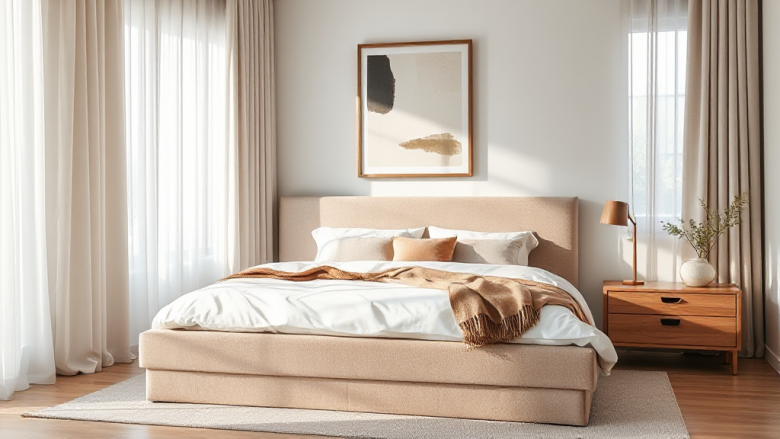
You’ve tidied the room. The floor is clear, the surfaces are wiped, the laundry basket is finally empty. And yet the bedroom still feels chaotic. That’s the strange truth about clutter: it isn’t the mess, it’s the visual noise. Too many colours, too many shapes, too many competing materials, and the eye never gets a place to rest. This is exactly where modern minimalist bedroom decor ideas earn their keep. Not as a style you copy from a showroom, but as a set of decisions about colour, texture, light and storage that quiet a room without stripping it of warmth. The goal isn’t an empty space. It’s a space that feels calm enough to sleep in and personal enough to want to be in.
Start With a Restricted Colour Palette, Then Break It Once
Minimalism fails when people confuse it with beige. A room painted entirely in one flat neutral often reads as cold or unfinished, because there’s nothing for the eye to hold onto. The fix is a tight palette with a deliberate accent.
Pick two base tones and one accent. A workable combination: warm off-white on the walls, a soft clay or mushroom tone on the textiles, and a single darker accent, such as charcoal or deep olive, used sparingly on the lamp base, the curtain edge or a framed print. Three tones is plenty. Four starts to feel busy again.
Warmth comes from undertones, not from adding colour. A white with a hint of yellow or red reads as cosy. A white with a blue or grey undertone reads as clinical. If you’re repainting, test a patch on the wall and look at it at night under your actual bedroom lighting, not in daylight in the shop. The same paint can look completely different after dark.
Why it works: a limited palette removes the visual competition that makes a tidy room feel busy, while warm undertones stop it tipping into cold.
Choose Furniture With Simple Silhouettes and Visible Air
Furniture shapes do more for a minimalist bedroom than any amount of decluttering. The rule of thumb is simple: fewer legs, cleaner lines, and space underneath.
A bed with a low, solid headboard in one material reads calmer than a bed with a scrolled or panelled frame. A nightstand with a single drawer and slim legs lets the floor show through, which makes the room feel larger and lighter. If you have the space, swap a bulky wardrobe for a slim open rail or a low chest of drawers, keeping the tallest storage away from the bed so the sleeping area stays visually low.
Match the finish across pieces but not the exact tone. Two woods in similar warm tones sit together comfortably; three different finishes start to look accidental. If you’re working with what you already own, paint mismatched pieces the same colour rather than replacing them. A single consistent finish will do more than new furniture.
Keep the bed as the clear focal point. Everything else should be slightly quieter in scale and tone. When a room has one obvious centre, the eye stops scanning and the whole space feels settled.
Layer Textiles for Softness Without Visual Weight
This is where most minimalist bedrooms go wrong. They strip back the soft furnishings along with everything else, and the result is a room that looks like a waiting area. Texture is what makes minimalism liveable.
Build layers in one colour family rather than several. A linen duvet in oatmeal, a cotton throw in a slightly deeper sand, and a wool cushion in the same range will feel rich without adding pattern. Add one textural contrast, such as a bouclé cushion or a chunky knit throw, to stop the bed looking flat.
Watch your proportions. Two large cushions look calmer than five small ones. A throw folded across the lower third of the bed reads more considered than one draped over a corner. If you like pattern, keep it to a single element, such as a subtle stripe on the throw, and let everything else stay plain.
Curtains matter more than people expect. Floor-length curtains in a tone close to the wall make the room feel taller and softer. Short curtains in a contrasting colour chop the wall into sections and undo the calm you’ve built.
Why it works: texture gives the eye something to enjoy without adding colour or pattern, which is what keeps a pared-back room feeling warm rather than bare.
Use Layered Lighting Instead of One Overhead Source
A single ceiling light is the fastest way to make a minimalist bedroom feel harsh. Minimalist rooms depend on light more than decorated ones do, because there’s less to distract from bad lighting.
Aim for three layers. First, ambient light: a dimmable ceiling fixture or, better, a pair of wall lights either side of the bed. Second, task light: a small bedside lamp with a warm bulb, ideally around 2700K, positioned so the light falls on the page rather than into your eyes. Third, accent light: a low floor lamp in a corner, or a strip of warm light behind the headboard to wash the wall.
Put every source on a dimmer if you can. The difference between a bright bedroom at 9pm and a dim one at 11pm is what tells your body the day is ending. Choose shades in opaque or lightly textured materials rather than clear glass, which throws hard shadows.
Keep fixtures visually quiet. Slim metal arms, matte finishes and simple drum or cone shades suit the minimalist look. Ornate bases and crystal details fight against everything else in the room.
Hide Storage Properly, Not Aggressively
Minimalism isn’t about owning less, it’s about where the things you own actually live. Good storage removes the visual noise without making the room feel like a showroom with nothing in it.
Under-bed drawers are the single most useful addition in a small bedroom, because they use space that’s already invisible. A bed with built-in storage solves the problem of where the spare bedding goes. For everything else, closed storage beats open shelving in a bedroom almost every time. Open shelves invite display, and display invites clutter.
If you do want open storage, limit it to one surface. A single shelf above a desk or a small tray on the nightstand is enough. Give it three objects at most, vary their heights, and leave space around them. Empty space is part of the design, not a gap waiting to be filled.
Deal with cables before anything else. A charging cable coiled on a nightstand undoes an otherwise calm surface. Route cables behind furniture, use a single multi-port charger, and keep the visible run as short as possible.
Why it works: hidden storage removes the daily visual noise that makes a tidy room still feel chaotic, while a single open surface keeps the room from feeling sterile.
Add Finishing Touches That Carry Personality
A minimalist bedroom still needs something that says a person lives there. The trick is to choose a few pieces with weight rather than many small ones.
One large piece of art above the bed does more than a gallery wall of small frames. Choose something with a limited palette that echoes your accent colour, and hang it low enough that it relates to the headboard rather than floating near the ceiling. A single sculptural object on a chest of drawers, a ceramic vase, a stack of two or three books you actually reread, or a small plant with clean leaves all work.
Bring in one natural material somewhere: a rattan pendant, a wooden stool, a stoneware lamp base. Natural materials age well and add warmth that painted surfaces can’t. Keep the count low. Three considered objects across the whole room will read better than ten scattered ones.
Finally, consider what you see last thing at night. If your bedside surface holds a lamp, a glass of water and nothing else, the room will feel calm every time you turn towards it. That small view is the one that matters most.
Modern minimalist bedroom decor ideas aren’t really about removing things. They’re about deciding what deserves to stay, then giving it room to breathe. Start with the palette, simplify the furniture, layer in texture, sort the lighting, hide what doesn’t need to be seen, and finish with a few pieces you genuinely like. Do it in that order and the room will feel calmer at every stage, not just at the end.