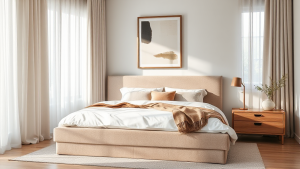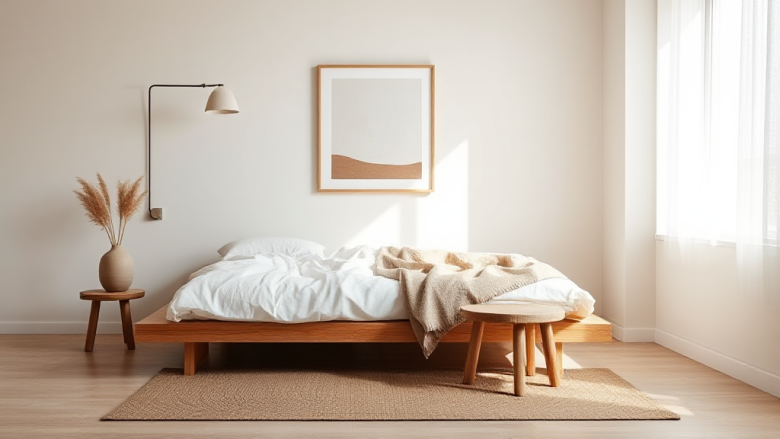
Stand in your bedroom doorway and decide how you want to feel. Calm, unhurried, slightly cocooned, able to put your bag down and exhale. Now work backwards from that feeling to the objects that create it. That’s the whole method behind modern minimalist bedroom decor ideas, and it’s the rule I use with renters and first-time buyers who want a serene room without spending like a hotel designer.
Minimalism gets a bad reputation for looking cold, but that’s usually a styling failure, not a philosophy problem. Bare walls, hard floors, grey everything and one sad cactus is not minimalism; it’s a waiting room. Real minimalism is edited, not empty. Below are five ideas I reach for again and again, each with why it works and how to actually do it on a normal budget, followed by a quick palette and texture checklist you can keep on your phone while you shop.
1. Build the room on a restrained three-colour palette
Why it works: When every surface speaks at the same volume, your eye has nowhere to rest. A tight palette does the quieting for you, and it makes cheap furniture look considered rather than mismatched.
How to do it: Pick one base, one mid-tone and one accent. A base might be warm off-white or soft oatmeal walls; the mid-tone is your wood, linen and upholstery; the accent is a single deeper shade in a cushion, throw or ceramic. I’d rather see three colours used generously than six used timidly.
For renters, paint is often off the table, so treat your existing wall colour as the base and work around it. If your walls are a cool rental white, warm the room with oak or rattan, a linen duvet in a cream that leans yellow rather than blue, and a lamp with a warm bulb. Those three moves alone will stop the space feeling clinical. If you can paint, choose a colour that reads as a tinted neutral rather than a statement, and paint the ceiling the same shade in a slightly lighter mix so the room doesn’t feel capped. A single can of paint is one of the few decor purchases that changes everything and costs very little.
2. Layer three textures so minimalism stays soft
Why it works: Warmth in a minimalist bedroom comes almost entirely from texture, not pattern. Texture catches light unevenly, and that unevenness is what reads as comfort.
How to do it: Aim for one smooth, one nubbly and one fluffy surface in the main view. Smooth could be a painted wall or a flat lampshade; nubbly is linen, slubby cotton or a woven basket; fluffy is a wool rug, a chunky knit throw or a boucle cushion. Three is enough. Four starts to look busy.
Budget-friendly swaps that punch above their price: a washed linen duvet cover, a flatweave or jute rug under the bed, and one heavy throw folded at the foot rather than draped everywhere. If you have hard flooring, a rug is not optional in my book, because it absorbs sound as well as softening the floor. Choose the largest size you can afford, ideally extending about 60cm past each side of the bed, because a postage-stamp rug next to a double bed makes the whole room look mean. Second-hand wool rugs are often better quality than new synthetic ones at the same price, and a good clean sorts most of them out.
3. Use one sculptural light instead of five small ones
Why it works: Lighting is where minimalist bedrooms are won or lost. A single well-placed, dimmable light source at eye level flatters faces, walls and fabric, while a grid of bright ceiling spots flattens the entire room.
How to do it: Keep overhead lighting for cleaning and dressing, then create a second, softer layer for evenings. A paper or linen drum shade on a bedside table, a slim floor lamp in a corner, or a plug-in wall light if you can’t rewire, all do the job. Warm bulbs around 2700K and a dimmer or smart plug will change the mood more than any new furniture.
Renters, look for plug-in wall lights and lamps with inline switches. They need no electrician and leave no holes. Place the lamp so the shade sits roughly at shoulder height when you’re sitting up in bed, and angle it slightly away from your face. If your room only has one bedside table’s worth of space, a wall light on one side and a small stool on the other is a perfectly good asymmetric solution. Nobody is measuring.
4. Choose furniture with visible legs and clear floor space
Why it works: Empty floor is the cheapest luxury in a small bedroom. Furniture that sits on legs lets the eye travel underneath, so the room reads as larger and lighter even when the footprint hasn’t changed.
How to do it: Where you can, swap a solid boxy bed base or chest for something raised on slim legs. A wooden bed frame with a low headboard, a stool instead of a bulky chair, a narrow console instead of a wide dresser. Keep the space under the bed either completely clear or filled with uniform, shallow storage boxes that disappear.
One chair is usually one too many. Bedrooms accumulate a chair that holds clothes, and that chair is the single biggest saboteur of a calm room. If you genuinely need somewhere to sit, choose a small stool or bench that tucks under a window or at the foot of the bed, and commit to keeping its surface clear. A lidded basket beside the bed handles the clothes that would otherwise land there. If storage is tight, a bed with drawers or an ottoman base earns its keep, but only if you actually keep it closed.
5. Edit the walls down to one or two deliberate pieces
Why it works: A single well-scaled artwork or mirror gives the eye an anchor. A scattered gallery wall gives it homework. In a minimalist bedroom, the wall should feel decided, not decorated.
How to do it: Choose one piece that’s larger than you think you need, and hang it so its centre sits around eye level, roughly 145cm from the floor, or about 20 to 25cm above the headboard if it’s above the bed. A round mirror opposite a window bounces light around a dark room beautifully and costs less than most art.
If you want two pieces, treat them as a pair: same frame, same size, hung in line. Skip the small prints scattered at different heights, the inspirational wording, and the shelves of tiny objects. If you’re renting and can’t drill, lean a large framed print on a shelf or the floor against the wall, or use removable adhesive strips rated well above the weight of the frame. Give the artwork breathing room; at least 15cm of bare wall on every side stops it looking cramped.
Quick palette and texture checklist
Before you buy anything, run the room through this short list. It takes two minutes and saves a lot of returns.
- Three colours maximum: one base, one mid-tone, one accent.
- Three textures in view: smooth, nubbly, fluffy.
- Two light sources: overhead for tasks, warm and dimmable for evenings.
- One anchor on the wall, scaled generously and hung at eye level.
- Floor space visible under at least one piece of furniture.
- Every surface has a job, and nothing lives on the bed but bedding.
If a new purchase fails two of those tests, it probably isn’t the right one, however much you like it in the shop. That’s not a rule about taste; it’s a rule about how the room will feel when you walk in at the end of a long day.
Edit over time, not in one weekend
The best minimalist bedrooms I’ve stood in were not finished in a single shopping trip. They were edited. Something came in, something else quietly left. A cushion that never got used went to a charity shop. A lamp that was too bright got a new shade. A stack of paperbacks migrated to a shelf in another room.
So start with the palette and the lighting, because those two changes cost the least and do the most. Live with the room for a fortnight. Notice what you reach for and what you step around. Then remove one thing you don’t love, and add one thing you do, and repeat that slowly. Minimalism isn’t about owning less for its own sake; it’s about keeping only what earns its place, so that everything left in the room is something you actually like looking at. Do that, and the calm you wanted when you walked in will be there waiting for you every evening.