You finally found it. The piece you have been scrolling past for weeks, the one that made you stop and imagine it above the sofa. It arrives, you hang it, you step back, and something is off. The art is beautiful, but it looks like a postage stamp floating in a sea of empty plaster. If that sounds familiar, you are in good company. I see it in friends’ homes constantly, and I have made the mistake myself more than once.
Here is the thing nobody tells you at the gallery or the checkout page: size matters more than style. A modest print scaled correctly will always look more expensive and more intentional than a large canvas that is the wrong shape for the wall. Learning how to choose the right wall art size is really just a handful of measurements and one reliable rule. Get those right and almost any piece will settle into a room like it was made for it.
The 2/3 Rule, Explained Simply
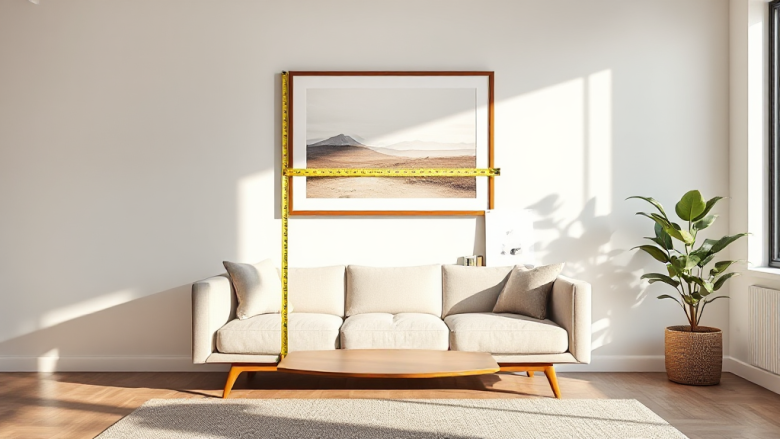
Most designers work to a rough proportion: artwork, or a group of pieces hung as one composition, should span roughly two-thirds to three-quarters of the width of the furniture below it. Not the width of the wall, which is where most people go wrong. The sofa, the console, the bed, the sideboard. That is your anchor.
Say your sofa is 200cm wide. Two-thirds of that is about 133cm. So the art above it, whether that is one wide canvas or three smaller frames hung together, should occupy somewhere between about 133cm and 150cm. That single number changes everything. Suddenly you are not guessing whether a 60cm print is big enough. You know it is not, unless you plan to hang two or three of them side by side.
The rule works because it creates a visual relationship. When art is too small relative to the furniture beneath it, the eye reads it as an afterthought. When it is too large, the piece starts to feel like it is pressing down on the room. The two-thirds to three-quarters range sits in the comfortable middle where the art and the furniture seem to belong to each other.
A few nuances worth knowing. The rule applies to the combined width of a gallery arrangement, not to each individual frame. If you are hanging a single tall portrait above a narrow console, width is less useful than height, so think in terms of the piece filling roughly two-thirds of the vertical space between the console top and the ceiling line you are working to. And in a hallway or above a staircase, where there is no furniture to anchor to, use the width of the wall section between two openings instead, and aim for the same proportions.
One more thing. The rule is a starting point, not a law. A deliberately oversized piece can look fantastic in a minimalist room where the art is the only thing on the wall. A small, tightly grouped cluster can work above a reading chair. But you should break the rule on purpose, not by accident, and knowing the baseline is what lets you do that.
Measuring Your Space: A Quick Checklist
Before you buy anything, spend ten minutes with a tape measure and a pencil. It will save you a return, a repaint, or a wall full of unnecessary holes.
Start with the anchor width. Measure the furniture the art will sit above, from outer edge to outer edge. Write that number down. Now work out your target range: two-thirds of that number at the low end, three-quarters at the high end. That is your horizontal budget.
Next, measure the available height. The gap between the top of the furniture and the ceiling is your vertical canvas, but you rarely want to fill all of it. A useful guideline is to leave roughly 15cm to 30cm of breathing room above the furniture and a similar amount below the ceiling, then see what is left. If your sofa is 80cm tall and your ceiling is 240cm, you have 160cm of gap. Take away 20cm at the bottom and 25cm at the top and you are working with roughly 115cm of usable height. That is plenty for a large portrait or a wide landscape, and it tells you instantly that a 30cm square is not going to cut it.
Then decide on orientation before you fall in love with a specific piece. Wide, low furniture like a sofa or a bed calls for a horizontal composition. Tall, narrow spaces like the gap between two windows or beside a doorway suit a vertical piece. Stairwells, which rise diagonally, often work best with a staggered grouping that follows the slope.
Finally, mark it out. This is the step people skip and regret. Cut newspaper or brown paper to the exact dimensions of the art you are considering, tape it to the wall, and live with it for a day. You will notice immediately if it feels too small, too large, or hung at the wrong height. It costs nothing and it is the closest you will get to a preview.
While you are up there, check the hanging height. The centre of the artwork, or the centre of the whole composition if you are hanging several pieces, should generally sit at around 145cm from the floor. That is roughly eye level for most adults and it is the standard galleries use. Above furniture, a common approach is to leave 15cm to 25cm between the top of the sofa or console and the bottom edge of the frame. If you are hanging above a bed, give it a little more, around 20cm to 30cm, so it does not feel like it might fall on you.
Common Sizing Mistakes and How to Avoid Them
The single most common mistake is buying art that is too small. It happens for understandable reasons. Small pieces are cheaper, they are easier to carry home, and online product photos make everything look substantial because they are shown on a wall with nothing else around them. A 40cm by 50cm print can look generous in a listing and tiny in a real living room. If you are torn between two sizes, and the larger one is within your measured range, go larger. It is almost always the right call.
The second mistake is measuring the wall instead of the furniture. A vast blank wall above a small desk does not need a vast piece of art. It needs a piece sized to the desk, with the remaining wall left alone. Empty wall is not a problem to be solved. It is part of the composition, and it gives the art room to breathe.
Hanging too high is the third classic error. People tend to hang art at the height that feels natural when they are standing with a hammer in hand, which is usually too high. Remember the 145cm centre line and the gap above the furniture. If you are hanging a group, treat the whole group as one shape and centre that shape at the same height.
Then there is the mismatched group. Three frames of wildly different sizes hung in a row will look accidental unless the arrangement is deliberate and balanced. If you want a gallery wall, decide on a grid or a centred cluster before you buy, and choose frames that relate to each other in size. A common approach is one large anchor piece surrounded by smaller ones, with even gaps of around 5cm to 8cm between frames.
Finally, forgetting the frame. A frame and mount can add 10cm or more to each side of a print. That changes your measurements. Always work from the finished, framed dimensions, not the size of the paper.
As a quick reference: above a two-seater sofa, look for a combined width of roughly 100cm to 130cm. Above a three-seater, roughly 130cm to 160cm. Above a king bed, roughly 140cm to 170cm. Above a console table, roughly 90cm to 120cm. Above a desk, roughly 70cm to 100cm. Above a fireplace mantel, roughly the width of the mantel itself, minus a little. Centre everything at around 145cm from the floor, leave 15cm to 25cm above the furniture, and you will be close to right every time.
Frequently Asked Questions About Wall Art Size
How do I choose wall art size for a large empty wall?
Do not try to fill the whole wall. Anchor the art to a piece of furniture or to a defined section of the wall, and size it to that anchor using the two-thirds rule. If there is genuinely no furniture, divide the wall into sections by windows, doors or corners and treat each section as its own space. A large piece that relates to something below it will always look better than a piece stretched to cover a wall.
Should all the frames in a gallery wall be the same size?
Not necessarily, but they should relate to each other. A single large anchor piece with smaller frames around it is a reliable formula, as is a grid of identical frames. What looks accidental is a row of frames in three or four unrelated sizes with no clear centre. Plan the arrangement on paper first, using the finished framed dimensions.
What if my art is slightly smaller than the two-thirds rule suggests?
You have options. Add a wide mount and frame to increase the finished size. Group the piece with one or two others to build a wider composition. Or hang it in a smaller, more intimate spot, such as above a bedside table or in a hallway, where the proportions work. What you should avoid is hanging a small piece alone on a large wall and hoping it will grow into the space.
Does the two-thirds rule work above a bed?
Yes, with a small adjustment. Measure the width of the bed frame, then aim for art that spans roughly two-thirds to three-quarters of that. Leave a slightly larger gap above the headboard, around 20cm to 30cm, so the art does not crowd anyone sitting up in bed. A single wide piece or a pair of matched verticals both work well here.