Almost every small room I’m asked to fix has already been painted white. The owner tells me this proudly, as if they’ve solved the problem. Then they open the door and the room still feels like a box. White walls, white ceiling, white floor, and somehow it’s smaller than before.
Here’s the uncomfortable truth: the standard advice about small rooms is mostly wrong. Painting everything white doesn’t enlarge a room. Emptying it out doesn’t either. What actually works is understanding how light behaves, how the eye judges scale, and how furniture placement changes the way a room reads before you’ve spent a penny on renovation. I’ve spent years working in small urban apartments, mostly rentals where I can’t move walls or rewire anything, and the tricks that genuinely work are the ones nobody puts on a listicle.
This is how to make a small room look bigger without knocking anything down, and without turning your home into a beige showroom nobody wants to sit in.
Light and Reflection: Stop Treating Windows as Decoration
The single biggest reason a small room feels cramped is that light dies before it reaches the back of the room. Not the amount of light coming in, but where it lands. A window with a heavy curtain, a dark sofa two feet in front of it, and a wall of shelving opposite means all that daylight stops at the sill.
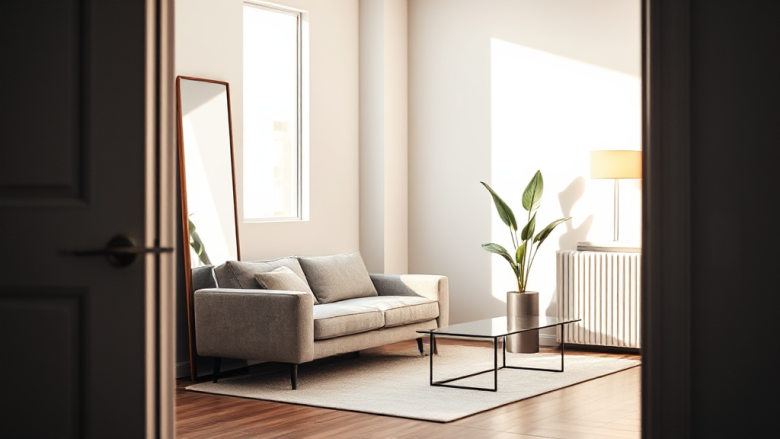
Reflection is the tool most people underuse. A mirror positioned to catch a window and bounce light across the room does more for perceived size than any paint colour. The trick is angle, not size. A tall, narrow mirror hung perpendicular to the window, so it faces the light source at an angle, throws brightness into the darkest corner. A mirror hung flat opposite the window just shows you the window again, which is pleasant but does nothing for depth.
Glass and glossy surfaces behave the same way. A glass coffee table, a lacquered sideboard, a polished floor: each one picks up light and repeats it. This is why a room with matte everything can feel heavy even when it’s bright. You don’t need to make the whole room shiny. One or two reflective anchors are enough, and they should sit low, where light actually falls.
Do this: hang a mirror at a slight angle to the window and keep the sill clear. Not that: cover the window with floor-length dark curtains and then wonder why the room feels like a cave at 2pm.
One more thing about light sources. A single ceiling bulb creates flat, even light that erases shadow, and shadow is what tells your eye how deep a room is. Two or three smaller pools of light, at different heights, create the contrast that reads as space. A floor lamp in the corner, a table lamp on a side surface, and a wall light near the window will make a small room feel layered. Layered rooms feel bigger. Flat rooms feel like waiting rooms.
Furniture Scale and Placement: The Leg Trick and the Float
Most people buy furniture that’s slightly too big because it looks generous in the shop. In a small room, that’s fatal. The rule I use is simple: measure the room’s narrowest walking path first, then buy furniture that leaves at least 60cm of clear floor along it. If a sofa eats that path, the room will feel blocked no matter how nice the sofa is.
Scale isn’t just about size, though. It’s about visual weight. A bulky sofa with a solid skirt to the floor looks like a wall. The same sofa on visible legs, with floor showing underneath, reads as lighter and lets the eye travel beneath it. That gap of floor is doing real work. It’s the cheapest trick in this article and the one people resist most, because skirted sofas feel more expensive.
Placement matters as much as shape. Pushing every piece of furniture against the walls seems logical: it maximises the middle. In practice, it creates a ring of dead space around the edges and a big empty centre, which makes the room feel like a corridor. Pulling a sofa or armchair slightly away from the wall, even by 15cm, and floating a rug under it, creates a defined zone. Defined zones read as intentional. Intentional rooms feel calmer and, oddly, larger.
Do this: choose a low-backed sofa on legs and float it a hand’s width off the wall. Not that: buy the deepest, tallest sofa that fits the wall and push it flush, then add a matching oversized armchair opposite.
Rugs are worth a mention here because so many small rooms get this backwards. A tiny rug in the middle of a small room shrinks it further, like a postage stamp on a large envelope. A rug that runs under the front legs of the main seating, and stops short of the walls, ties the furniture together into one shape. One shape is easier to read than five separate objects.
Colour and Contrast: Why All-White Fails and One Dark Wall Works
Let’s deal with the white myth properly. White walls reflect light, yes, but they also remove depth cues. When every surface is the same tone, your eye has nothing to measure against, and the room flattens. A completely white small room often feels like a white box, not a spacious one.
What actually helps is contrast at the right edges. A darker floor with lighter walls gives the eye a base and a height, which stretches the room vertically. A darker ceiling with lighter walls does the opposite, pulling the ceiling down, so avoid that unless you’re deliberately trying to make a tall narrow room feel cosy. In a small room, keep the ceiling lighter than the walls and the floor darker than both.
One dark feature wall can work, but only if it’s the wall you want to push away, usually the one opposite the window. Dark recedes. That’s the whole trick. Paint the far wall a deeper shade, keep the adjacent walls pale, and the room gains a false back wall several feet further than it really is. Paint the wall beside the window dark and you’ve just made the room feel narrower.
Do this: pale walls, mid-tone floor, one deeper wall opposite the window. Not that: white walls, white ceiling, white floor, and a dark accent wall next to the door.
Colour also applies to the things in the room, not just the room itself. A single strong colour used in two or three places, a cushion, a lamp base, a piece of art, creates a visual thread that pulls the eye around the space. That movement reads as room to move. Scattering ten different colours does the reverse: the eye stops at every object, and a room full of stopping points feels crowded.
Smart Storage: Built-In Thinking Without Building Anything
Clutter is the fastest way to shrink a small room, and the fastest way to fix it isn’t buying more boxes. It’s deciding what deserves to be visible. Anything you use daily can stay out. Everything else should be behind a door, a drawer, or a lid. Open shelving in a small room is a trap, because open shelves display your clutter as decoration.
Where you put storage matters too. Vertical storage works because the eye doesn’t count height the way it counts floor space. A tall, shallow bookcase or a column of closed cabinets uses the wall without stealing floor. The key word is shallow: 30cm deep is plenty for most things, and anything deeper turns into a place where objects go to be forgotten.
Furniture that does two jobs is your best friend here. A bed with drawers underneath, an ottoman that opens, a bench with storage inside. Each one removes an object that would otherwise need its own footprint. In a rental, freestanding pieces like these are the whole game, because you can’t build in.
Do this: use tall, shallow, closed storage along one wall and put daily items on a single tray or shelf. Not that: line every wall with open cube shelving and fill it with miscellaneous objects you’ll never look at again.
One caution: don’t fill every surface. A room with no empty space anywhere feels tight even when it’s tidy. Leaving one wall, or one stretch of wall, completely bare gives the eye somewhere to rest. Rest reads as space.
The Short Version
Small rooms don’t get bigger from a single paint colour or from emptying them out. They get bigger when light reaches the back of the room, when furniture shows floor beneath it, when contrast gives the eye something to measure, and when storage hides the things you don’t need to see. Fix the light first, because it’s free. Then look at what’s touching the floor. Then think about colour. The room you already have is probably capable of more than you think.