Walk into any kitchen showroom and you’ll be hit with a wall of choices. Fluted oak here, matte black there, a slab of veined quartzite that costs more than a used car. It’s overwhelming, and the pressure to get it right is real. A kitchen is the most expensive room most people ever renovate, and unlike a paint colour you can live with for a year and change, cabinetry and stone are commitments.
I’ve spent over a decade advising homeowners through exactly this decision. The question I hear most isn’t “what’s trending?” — it’s “will I regret this in five years?” That’s the right question. So this is a filter, not a catalogue. Below I’ve separated the modern kitchen interior design trends that have genuine staying power from the ones that look exciting in a magazine spread and tired by the time the grout dries. Each section pairs a trend worth backing with one I’d gently talk you out of.
Materials: Honest Surfaces Over High-Drama Statements
The lasting move is toward materials that age with grace. Think quartzite with real mineral variation, soapstone that patinas, and honed rather than polished finishes that hide the daily reality of cooking. Solid wood — even in small doses like an open shelf or a butcher-block island top — is back because people are tired of surfaces that feel like plastic. These materials cost more upfront, but they don’t date. A honed natural stone worktop looked good a decade ago and will look good a decade from now.
The fading trend is the full-height, heavily veined slab splashback in a dramatic book-matched pattern. It photographs beautifully. In practice, it’s expensive, it’s unforgiving if you cut it wrong, and the very drama that made it striking becomes visual noise once you’ve lived with it for two years. Bold veining also fights with everything else in the room, which forces you to keep the rest of the kitchen bland to compensate. I’ve seen homeowners spend a fortune on a statement stone and then regret that they can’t add a colourful accessory without the room feeling chaotic.
There’s a related shift worth noting: people are moving away from glossy finishes entirely. High-gloss lacquer shows every fingerprint and smudge, and in a working kitchen that means constant wiping. Matte and honed surfaces are more forgiving and, frankly, more sophisticated.
Colour Palettes: Warm Neutrals Are Replacing Cold Grey
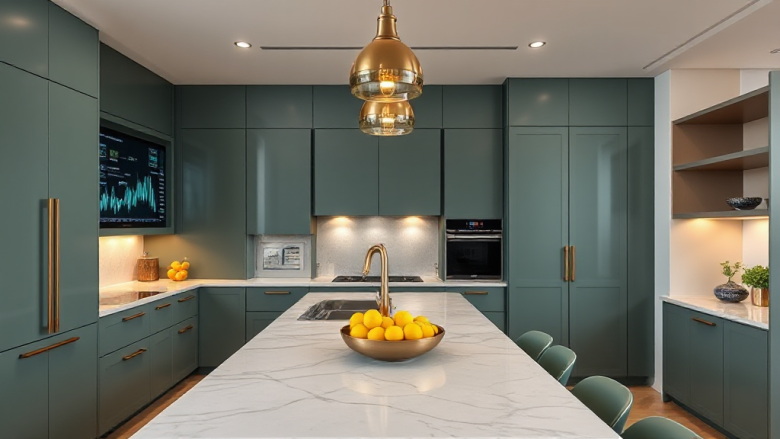
For years, the default kitchen was grey. Grey cabinets, grey walls, grey floors, with a white worktop to break it up. That era is closing. The palette with real longevity now is warm neutrals — mushroom, clay, oatmeal, soft taupe, and deep earthy greens used on lower cabinets with a lighter tone above. These colours feel calm, they work with both natural wood and stone, and crucially they don’t scream a specific year the way cool grey does.
The passing trend is the all-white, high-contrast kitchen with black accents — the so-called “Scandi monochrome” look that dominated the 2010s. It’s not ugly, but it’s become so ubiquitous that it reads as generic. It also shows every crumb and splash, which is a practical problem in a room designed for mess. If you already have it, you don’t need to rip it out. But if you’re starting fresh, a warm neutral base gives you far more flexibility and a longer shelf life.
One colour note that’s genuinely durable: two-tone cabinetry, where the base units are darker and the wall units lighter. This has been around long enough to prove it isn’t a fad, and it adds depth without committing to a single bold colour across the whole room.
Storage Innovations: Clever Internals Beat Open Display
The storage trend I’d back every time is invisible organisation. Pull-out larders, deep drawers instead of base cupboards, internal drawer dividers, and corner solutions that actually use the dead space. These aren’t glamorous, but they’re the difference between a kitchen that works and one that looks tidy only in photos. The principle is simple: the best storage is storage you don’t see. When everything has a home behind a closed door, the room stays calm even on a chaotic Tuesday.
The fading trend is open shelving as a primary storage strategy. It looks lovely in a styled photograph with three ceramic bowls and a sprig of eucalyptus. In real life, open shelves become a dumping ground for mismatched mugs and half-used spice jars, and they collect grease in a way that closed cabinetry doesn’t. A single open shelf used deliberately is fine. A whole wall of them is a maintenance job you didn’t sign up for.
There’s also a quiet move away from the appliance garage and other gadgets that promise to hide clutter but end up eating counter space. Homeowners are realising that fewer, better-organised cabinets beat clever contraptions.
Lighting: Layered Light Over a Single Statement Fixture
The lighting approach with staying power is layering. That means ambient light from ceiling fittings, task lighting under wall units and over the hob, and accent lighting inside drawers or along a toe kick to make the room feel considered. Dimmable warm-white LEDs on separate circuits let you shift the mood from bright prep mode to soft evening mode. This is the single change that makes the biggest difference to how a kitchen feels, and it’s relatively cheap compared to cabinetry.
The fading trend is the oversized pendant cluster over an island. Three matching pendants in a row, or a sculptural chandelier, can look striking — but they often cast harsh shadows right where you’re chopping, and they date faster than almost anything else in the room. Lighting trends move quickly, and a fixture that feels fresh this year can feel dated in three. If you love a statement piece, keep it on a dimmer and don’t rely on it for task light.
One practical tip: put your task lighting on its own switch, separate from the ambient circuit. It’s a small wiring decision that gives you far more control later.
Technology Integration: Invisible Function Over Visible Gadgets
The technology trend that will last is the invisible kind. Induction hobs that are faster and safer than gas, integrated charging surfaces, smart lighting that adjusts automatically, and appliances that report a fault before it becomes a flood. These are genuinely useful, and they’re becoming standard rather than exotic. The key is that they should disappear into the design, not announce themselves.
The fading trend is the kitchen as a showroom for visible tech — screens built into fridge doors, voice assistants shouting from every corner, and gadgets that solve problems nobody actually had. These features tend to be expensive, they date quickly, and they often break in ways that are costly to repair. A fridge with a built-in screen sounds futuristic until the screen fails and you’re left with a very expensive fridge with a dead panel.
The sensible rule is to invest in technology you’ll use daily and that improves how the kitchen functions, and to be sceptical of anything that exists mainly to look impressive. Wiring for future upgrades — extra sockets, data points, and space behind cabinets — is cheap now and invaluable later.
The Verdict: Spend Where It Ages Well
If you take one thing from all of this, let it be the principle underneath every pairing above. Trends that endure tend to be the ones that serve how you actually live: honest materials, warm colours, hidden storage, layered light, and technology that works quietly in the background. Trends that fade are the ones designed to be photographed — high-drama stone, monochrome white, open shelves, statement pendants, and visible gadgets.
That doesn’t mean you can’t have something striking. It means you should put your money into the bones of the room — the cabinetry, the worktop, the lighting infrastructure — and treat the dramatic flourishes as things you can change later without a full remodel. Paint a bold colour, hang a striking light, add a statement chair. Those are cheap to swap when your taste shifts. The quartzite is not.
So when you’re standing in that showroom, overwhelmed by options, ask one question of each choice: will this still feel right in ten years, or will I be explaining it to a buyer? If it’s the first, it’s worth your money. If it’s the second, it’s a trend you can admire from a distance and skip.